


Emergency department (ED) clinicians at the PA Hospital (PAH) are learning to speak up with more clarity, listen more closely and communicate with greater confidence, and thanks to PA Research Foundation donors, it's patients who will reap the benefits.
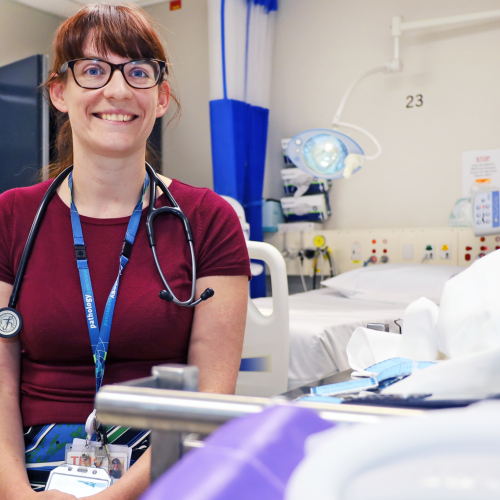
That's the finding of a pilot Coaching for Communication program funded by the Foundation and led by early career researcher Dr Victoria Lister, who worked one-on-one with 12 emergency medicine nurses and doctors in the PAH ED, across four short coaching sessions each.
The idea was simple but powerful: that better communication among the people caring for patients leads to safer, better care for the patients themselves.
When Victoria first began, she expected the biggest barrier would be fear. Instead, she found something quite different.
"It surprised me because as part of a separate project, my PhD, I'd spent the previous four years investigating employee silence in healthcare – a pervasive and troubling problem," she said.
"Because the issues that so affect so many hospital departments weren't present in the PAH ED, participants were free to focus on identifying and improving their communication deficits rather than worrying about ways to speak up without fear of the potential consequences for doing so."
Rather than supporting clinicians to overcome fear, Victoria used a solution-focused coaching approach that helped them find their own answers to their own communication challenges. And the results speak for themselves, with every participant who completed the program improving their self-rated communication, some reaching a perfect 10 out of 10 against goals they set for themselves.
One nurse, who rated her progress at 10, was determined to make headway.
"She knew her communication deficits were impeding her ability to communicate clearly and effectively on the floor," Victoria explained.
"As she said during one session, 'Once I know something, I can change'. This included learning to say 'No', being realistic about what was possible in terms of workload, stopping saying 'Sorry' when it wasn't called for, and bringing greater clarity to her communication. This latter concern was shared by many of the participants. Almost all wanted to improve the clarity of their communication and make sure they were truly able to close the loop, essential in an ED."
For the doctors, the work looked a little different. A junior doctor and an advanced trainee came to understand how feeling rushed was impairing their communication.
"Realising they needed to learn to slow down physically and verbally, and pause before speaking was important," Victoria said.
“For another advanced trainee, the focus was on referrals, how to negotiate and navigate different personalities and unwanted reactions, their own and those of the individual on the other end of the phone."
The link to patient care came through most strongly with the nurses, who spend the most time with patients.
"I recall one nurse who recognised she needed to be willing to listen more and be more diplomatic in her reactions to colleagues and patients," Victoria said. "She was able to start changing her behaviours, which had a positive effect on patients frustrated by waiting. Conversely, she also described holding her own in a way she hadn't been able to before in a situation that occurred in another ED where she worked from time to time, demonstrating the reach of the coaching."
What struck Victoria most was how one person's growth seemed to lift the whole team.
"One participant stated that when she was happy and confident in the ED, others were too. This augers well for patients and practitioners, and ED culture generally," she said.
"One reason coaching has powerful flow-on effects is that it is a very egalitarian practice. The coaching relationship is non-hierarchical, which gives people the opportunity to experience expressing themselves without fear or favour. That experience is very valuable as it opens the door to broader conversations that increase the potential for team sharing and therefore learning."
It's a philosophy Victoria believes shouldn't be reserved for those at the top.
"A lot of organisation-sponsored coaching is offered only to executives to enhance their performance, which I believe is short-sighted," she said. "Everyone, from cleaners and caterers to C-suite, can benefit from coaching. In the ED, everyone is a team-member leader, a phrase I used in my original proposal to describe the shared responsibility that exists among staff."
With the pilot complete, Victoria and her colleague would like to expand the program, so any ED clinician who wants to develop their communication skills can.
“Peer-coaching models are another option, where clinicians learn the basics and support one another. Embedding coaching into EM training is something my colleagues and I are also looking into now," she said.
"We would love the PAH ED to get involved with this initiative."
You can support research like Dr Lister's that improves care for patients at the PA Hospital by making the Foundation your place to give here.



2 Comments