
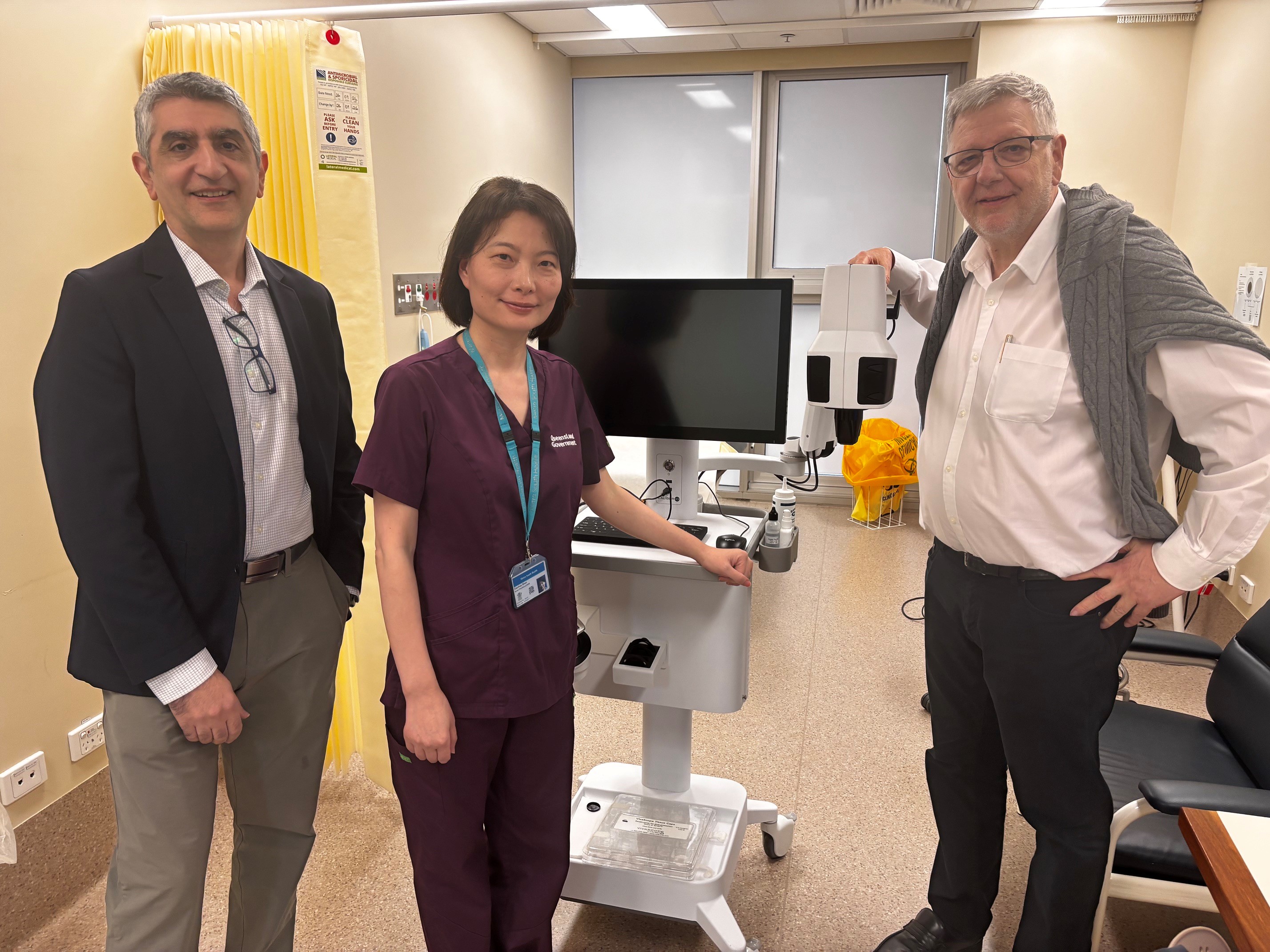
Thanks to PA Research foundation donors, PA Hospital’s Dermatology Department now has a cutting-edge piece of equipment with which to detect potential skin cancers.
Using a near infra-red laser to penetrate the superficial layers of the skin, the VivaScope 1500 offers physicians and researchers the possibility to non-invasively examine skin In Vivo, at cellular resolution and in real time.
It provides researchers and treatment teams a non-invasive view into the skin layers, from the epidermis at the surface all the way down to the superficial dermis of the patient.
PA Dermatology department Medical Director Professor Kiarash Khosrotehrani said thanks to the Foundation’s support the VivaScope was acquired so that the Hospital could improve outcomes for patients by reducing the need for potentially painful biopsies.
“In dermatology, we are always striving to improve diagnostic accuracy while minimising invasiveness for patients. The VivaScope stood out because it allows us to examine skin lesions at a near-cellular level in real time, without the need to immediately perform a biopsy,” he said.
“The biggest impact it will have will be in improving both accuracy and patient experience.
With the VivaScope, we may assess skin lesions on the spot and make more informed decisions without needing to perform an invasive biopsy. This reduces discomfort, scarring, and the anxiety of waiting for results.
PA Dermatology Department Nurse Practitioner Christine Shen said as a leading tertiary hospital, the VivaScope will add to the high standard of skin cancer research undertaken at the PA campus, which already boasts a VECTRA 3D imagine machine, the prototype of which was made possible by the Foundation.
“The VivaScope gives us a unique opportunity to study skin cancers in real time, at a microscopic level, without repeatedly removing tissue,” she explained.
“The VivaScope and the VECTRA are highly complementary technologies. The VECTRA 3D imaging system allows us to map and monitor the entire skin surface over time, identifying new or changing lesions. The VivaScope then allows us to examine those specific areas of concern in much greater detail at a cellular level.
“Together, they provide a comprehensive approach—from whole-body surveillance to microscopic analysis—which significantly strengthens our diagnostic accuracy.”
With every donation helping to drive research and improve outcomes for patients, support from donors whether it is big or small is both impactful and appreciated.
” Their support makes a significant difference every day to our patients. It helps bring advanced, world-class technology to our patients. This means earlier diagnoses, fewer invasive procedures, and better clinical outcomes,” Christine said.
For people considering making a major donations or choosing to leave a gift in their will to the Foundation are seen by researchers and clinicians as more than just a thank you for exceptional care but an investment in the future of healthcare.
“It enables us to continue investing in cutting-edge technology, support vital research, and train future clinicians. In skin cancer, where early detection is critical, these advances can save lives and significantly reduce the burden of disease.
“Their support would help shape the future of skin cancer care and research, ultimately improving outcomes for generations to come.”
To help enable the latest in skin cancer research technology, make the PA Research Foundation your place to give and donate today.