
Can cancer patients whose disease has metastasized to the brain get better outcomes if they undergo Gamma Knife Surgery prior to having their tumour removed?
That’s the focus of a new study made possible by those who choose the Foundation as their place to give.
The Gamma Knife Centre of Queensland at Princess Alexandra Hospital (PAH) is one of only two Gamma Knife facilities available in the public hospital system in Australia, and the only public service in Queensland. The machine is a non-invasive radiation technology that precisely targets brain tumors and other neurological conditions using highly focused gamma rays, acting like a "knife" without an incision by destroying unhealthy tissue while sparing surrounding healthy areas.
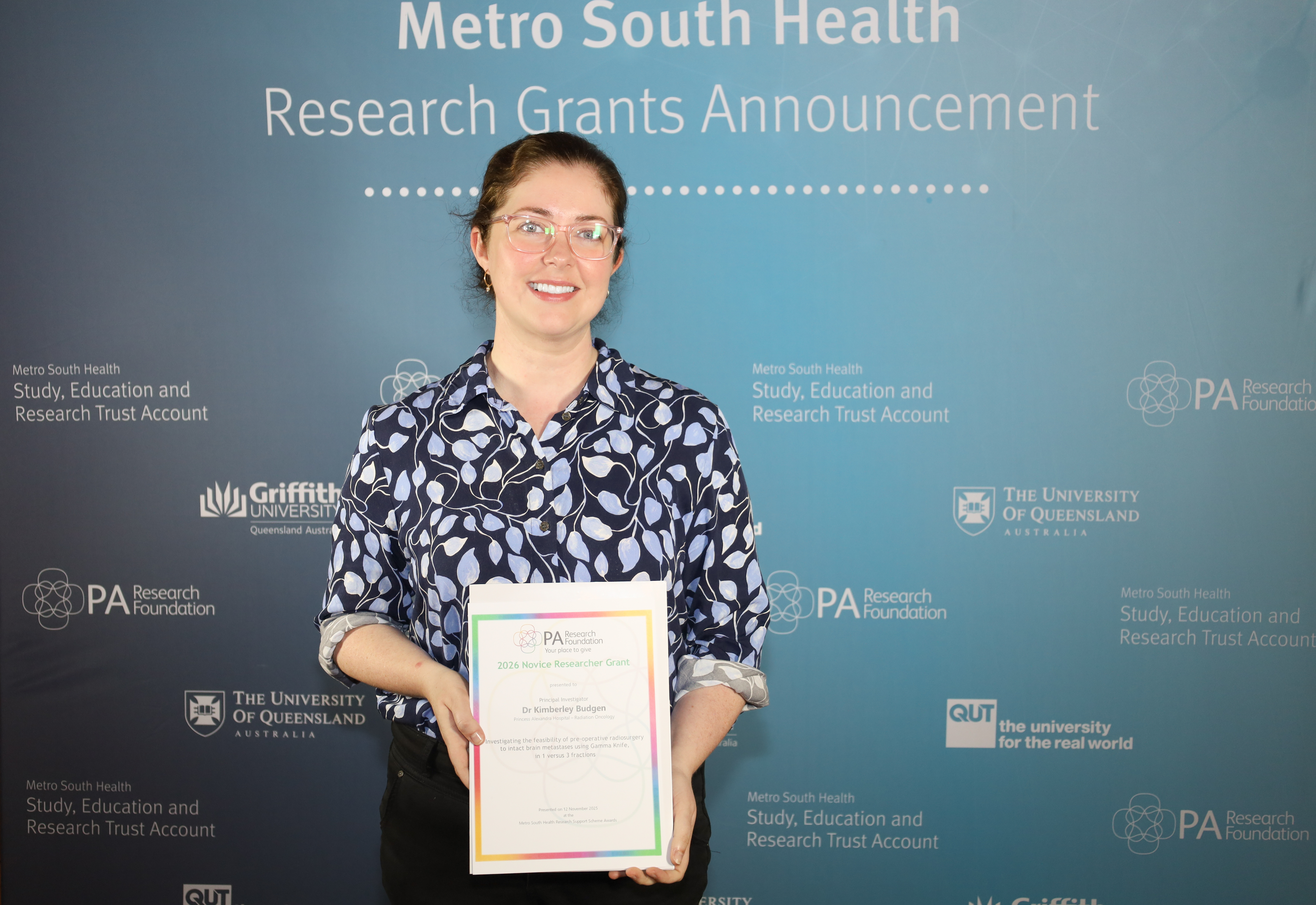
PA Hospital radiation oncologist Dr Kimberley Budgen said the study aims to improve outcomes for patients with brain metastases in a number of ways.
“If patients just have a metastatic brain tumor removed, over a couple of years the recurrence rate is up around 50% depending on what kind of cancer it is. That means any patient who has a brain metastasis removed has to then go on to have a course of radiation treatment.
“The gold standard historically has been surgery first and then, after the patient has recovered (which can take a number of weeks), do a course of radiation treatment. This remains the gold standard around the world and it's very good at controlling the rate of recurrence in the years to come – but there might be some advantages in switching around the order of radiation and surgery, which our new study is looking at.
“Where we think we can see an advantage in other studies is looking at lower rates of seeding of tumour around the surface of the brain, where it’s opened at the time of surgery. We think if you give radiation, in the days before surgery, years in the future you may decrease the chance of that cancer seeding along the surface of the brain.
“There's also a possible delayed consequence of radiation treatment which is an inflammatory scar tissue of the surrounding healthy brain tissue called radionecrosis, and we hope to see lower rates of that as well if we give the radiation before.”
The prospective study will not only enroll patients over the next two years but draw upon existing data and combine data with the Peter MacCallum Cancer Centre in Melbourne.
“There have been a number of other studies around the world, including some notable data out of our unit and Peter Mac in the past, looking at treating patients using pre-op gamma knife and in other departments using a linear accelerator to deliver pre-op stereotactic radiation.
“The questions that we have are around refining the correct ‘recipe’ for dosing these tumours, and how do we make the process seamless combining radiation and surgery back-to-back.
“In most courses of radiation, we deliver treatment broken up over a number of days. In the brain, usually somewhere between one and five days of treatment is how we treat metastatic tumours, but there is some uncertainty regarding how big a tumor has to be before we change from one to three days of treatment and a range of doses we can safely choose from.
“This new study at PA will help refine questions around the dose and timing of radiation before surgery and give us insights into how to make the process feasible in our unit. Once we combine that data with Peter Mac’s patients as well, we'll have more knowledge about the best dose and fractionation, in order to help patients.”
With PA’s Gamma Knife Centre of Queensland treating approximately 350 patients with brain metastases last year, the study can cast a wide net for patient recruitment. Dr Budgen added that the centre’s impact on patient outcomes has been boosted by ongoing support from the Foundation and its donors, including multiple fellowship positions and an equipment upgrade that allowed for more patients to be treated, something the wider cancer care team at the PA is incredibly grateful for.
“We're a statewide service and in fact we treat some patients from outside state lines as well. I think that's an important part of us joining in the conversation through research, is having the Queensland regional and rural communities and the indigenous communities that our centre serves, represented in the international body of data, that then tells us what to do for patients with different kinds of cancer,’ she said.
“The Gamma Knife Unit is incredibly indebted to the PA Research Foundation. We are proud of the work that we do, and a big part of that is thanks to the PA Research Foundation’s support.
“I think our unit has a great reputation around Australia and internationally because the Foundation has enabled us to participate and keep contributing to the international body of research.”