
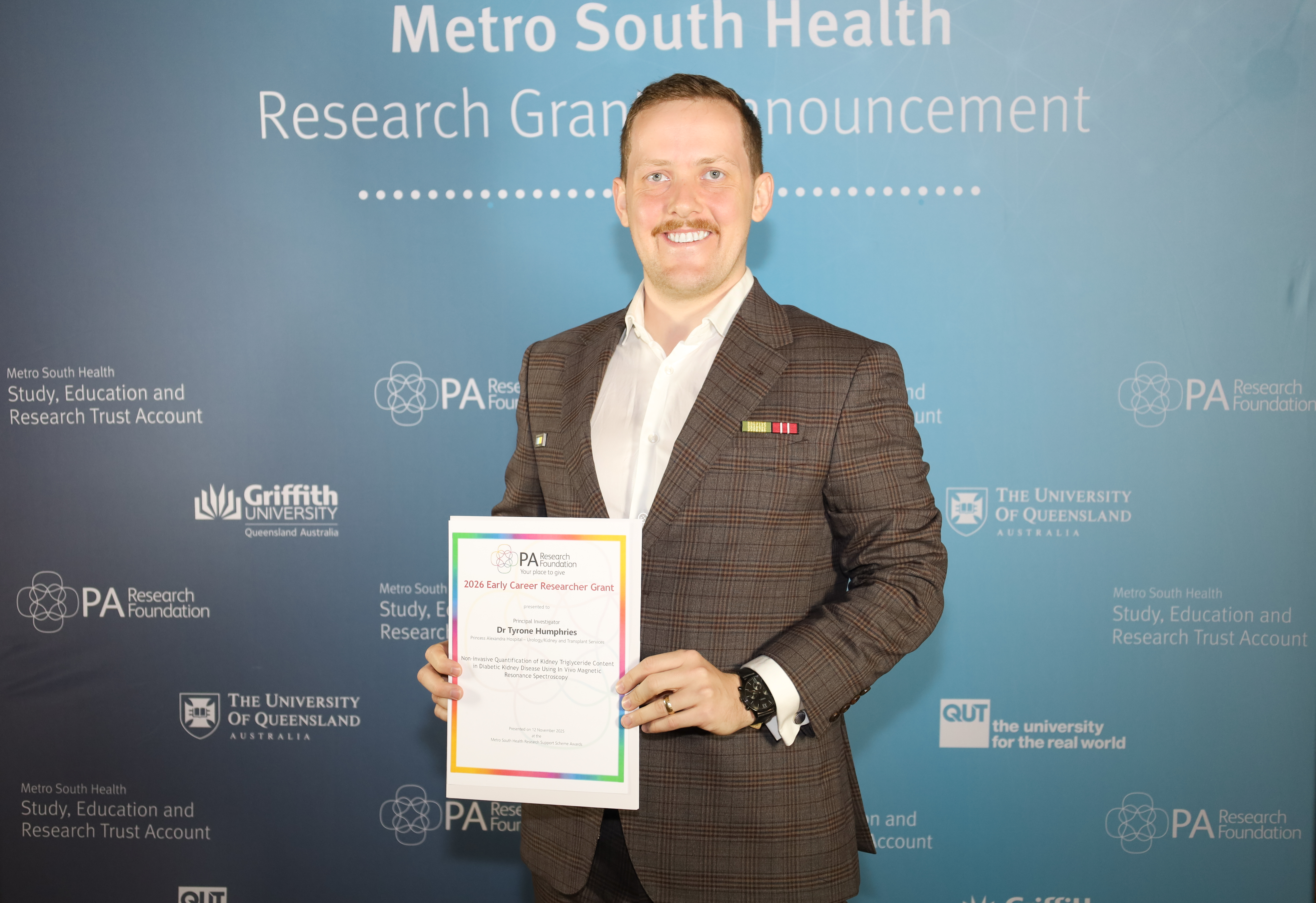
Can MRI technology be used to better inform the future and ongoing treatment of kidney disease patients? That’s the question PA hospital researcher Dr Tyrone Humphries is currently exploring thanks to incredible supporters like you.
Dr Humphries’ research explores the effectiveness of using advanced MRI techniques to examine the fat levels in the kidneys of diabetic kidney disease patients to hopefully offer clinicians a new tool to assess disease progression and inform treatment.
“Fat is a really good marker for how much scarring is present in the kidney and how well they are functioning. And the only real way to measure fat clinically is to perform a biopsy of the kidney,” he said.
“The technology itself, the MRI, is non-invasive. So that's the main sticking point… we're able to look at different levels of fat and water and other metabolites or small molecules in the kidney non-invasively without them having to have a needle stuck in the back, without them having to go through any discomfort.
“And most renal patients have had MRIs before, they're familiar with it, they know what it takes. It's a bit longer than a regular MRI. The bore of the machine is a bit narrower than a regular MRI. There are some restrictions around the size of the patient and whether they have claustrophobia or not. So, it's not a perfect method.
“We want to measure the fat accumulation and that could tell us whether they'll advance in disease or not, or the speed at which they'll advance in disease. We're looking at people with mid-stage disease. Because everyone experiences a different disease trajectory.
“A determinant of whether they progress fast or slightly might be how much fat or how much scarring they have in their kidneys.”
The research is one of two kidney-based studies Tyrone is currently undertaking with a second study funded by the TRI Foundation which is also based at the PA Hospital campus.
“We do have another study with the TRI Foundation where we are looking at transplant recipients with delayed graft function. That's just looking at whether we can tell if a kidney transplant is functioning from one that's not functioning.”
Dr Humphries who conducts research across multiple departments at the PA including gastroenterology is incredibly grateful to the Foundation’s donors because they have enabled him to continue his work in the renal space.
“This is what my PhD was on. It's still early days and the money from the PA Foundation is fantastic because I went so far on my PhD and wanted to take it further and I didn't have any money to do it,” he exclaimed.
“I've got fantastic clinicians all over nephrology, urology and radiology, who are very supportive but had no logistical support to take it further. That’s where the Foundation's really helping. It's fantastic.
“As a researcher, you can have all the passion for research that you want. And I've met fantastic researchers, but it is really the donors, they're the ones that make research happen. Because money makes the world go round. If we don't have money to fund our research, we can't do what we want to do and help people. That's the research landscape unfortunately, you need money to make the wheels turn and that's why I’m so thankful to all the donors.”
You can donate to kidney disease research such as Dr Humphries by making the Foundation your place to give here.