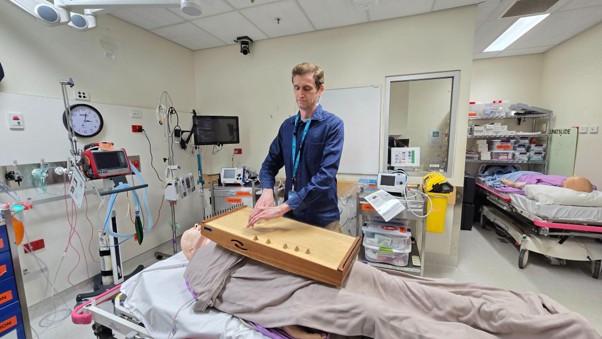
PhD researcher Gary Moody demonstrating the use of a Monochord instrument.
A strong passion and experience in playing woodwind instruments during his adolescence would unexpectedly become the key of Dr Gary Moody’s anthropology research in his adulthood.
Coming from a musical background of orchestra and bands, Dr Moody found this skill to be extremely helpful when it came to his project on trance states.
During his research, music was one of the talents that came up for exploration, and this started a journey of wellness and self-discovery. Early in Dr Moody’s research, he encountered a couple of monochord practitioners which ultimately set the course of his project.
“I was mesmerised by how they created these transformative spaces of peace, where people experienced vivid sensory and emotional phenomena. I became really intrigued by how these experiences, these people, go into trance states, going on vivid imaginative journeys through forests and across lakes, and how it had a role to play in wellbeing,” Dr Moody said.
Through an unexpected turn of events, Dr Moody soon found himself playing the instrument in a hospital’s mental health crisis unit.
“The music evoked magical experiences for patients. People would come in looking very unwell, and leave inspired, laughing, and even singing.”
This experience brought about a new perspective and motivation for Dr Moody. His anthropology research looked at how Spiritualist spirit mediums used trance states to help people access deeper parts of themselves, where natural talents and expressions can be hidden or undiscovered.
“There is something deeply intriguing about the Monochord and how it is played. It draws on spiritual healing traditions and involves embodied techniques that go beyond simply ‘music-playing’. Practitioners learn ways of guiding listeners into altered states, helping them connect with a more authentic part of themselves”.
In emergency medicine, stress and burnout are well-known challenges. A senior Emergency Department (ED) nurse who had experienced the instrument said that it would be highly beneficial and welcomed in the emergency department for staff.
“The work in the ED helped me explore and unpack these techniques, what I call “embodied technologies”, to evoke sensory experiences and trance states for unusual and powerful wellbeing and performance results,” Dr Moody said.
“Staff would come to me highly stressed, anxious and fatigued. I would play the instrument, sometimes for only five minutes, and they would return to the floor feeling restored, joyful, and in more of a flow state.”
A staff member who received a Monochord intervention before their shift later reported that they were able to respond more effectively to a major trauma incident. These examples suggested that the arts-based and spiritual-healing-informed interventions are successful in evoking flow states that enhance performance.
One major theme that emerged from the Monochord interventions was helping healthcare staff to normalise self-care. The music was able to take them to a place where they could genuinely focus on relaxing, and begin taking care of themselves. Dr Moody’s research explores spiritual healing and arts practices that are normally marginalised by mainstream culture and would not have been possible if not for the donors of the PA Research Foundation.
“The donors’ generosity didn’t just fund research, it directly supported the wellbeing of frontline healthcare workers.”
You can contribute to innovative anthropology and wellbeing projects for healthcare clinicians by making the PA Research Foundation your place to give here.
You can listen to the Monochord EP here.
Coming from a musical background of orchestra and bands, Dr Moody found this skill to be extremely helpful when it came to his project on trance states.
During his research, music was one of the talents that came up for exploration, and this started a journey of wellness and self-discovery. Early in Dr Moody’s research, he encountered a couple of monochord practitioners which ultimately set the course of his project.
“I was mesmerised by how they created these transformative spaces of peace, where people experienced vivid sensory and emotional phenomena. I became really intrigued by how these experiences, these people, go into trance states, going on vivid imaginative journeys through forests and across lakes, and how it had a role to play in wellbeing,” Dr Moody said.
Through an unexpected turn of events, Dr Moody soon found himself playing the instrument in a hospital’s mental health crisis unit.
“The music evoked magical experiences for patients. People would come in looking very unwell, and leave inspired, laughing, and even singing.”
This experience brought about a new perspective and motivation for Dr Moody. His anthropology research looked at how Spiritualist spirit mediums used trance states to help people access deeper parts of themselves, where natural talents and expressions can be hidden or undiscovered.
“There is something deeply intriguing about the Monochord and how it is played. It draws on spiritual healing traditions and involves embodied techniques that go beyond simply ‘music-playing’. Practitioners learn ways of guiding listeners into altered states, helping them connect with a more authentic part of themselves”.
In emergency medicine, stress and burnout are well-known challenges. A senior Emergency Department (ED) nurse who had experienced the instrument said that it would be highly beneficial and welcomed in the emergency department for staff.
“The work in the ED helped me explore and unpack these techniques, what I call “embodied technologies”, to evoke sensory experiences and trance states for unusual and powerful wellbeing and performance results,” Dr Moody said.
“Staff would come to me highly stressed, anxious and fatigued. I would play the instrument, sometimes for only five minutes, and they would return to the floor feeling restored, joyful, and in more of a flow state.”
A staff member who received a Monochord intervention before their shift later reported that they were able to respond more effectively to a major trauma incident. These examples suggested that the arts-based and spiritual-healing-informed interventions are successful in evoking flow states that enhance performance.
One major theme that emerged from the Monochord interventions was helping healthcare staff to normalise self-care. The music was able to take them to a place where they could genuinely focus on relaxing, and begin taking care of themselves. Dr Moody’s research explores spiritual healing and arts practices that are normally marginalised by mainstream culture and would not have been possible if not for the donors of the PA Research Foundation.
“The donors’ generosity didn’t just fund research, it directly supported the wellbeing of frontline healthcare workers.”
You can contribute to innovative anthropology and wellbeing projects for healthcare clinicians by making the PA Research Foundation your place to give here.
You can listen to the Monochord EP here.