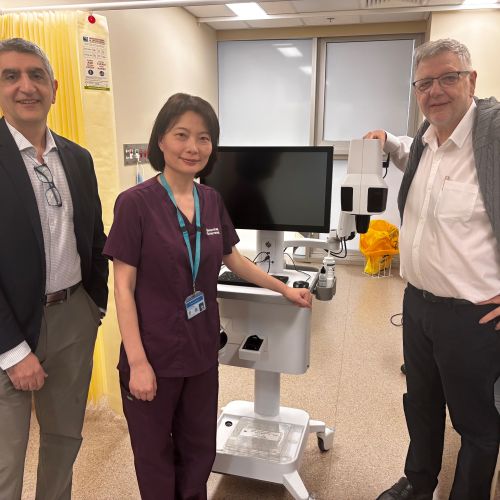

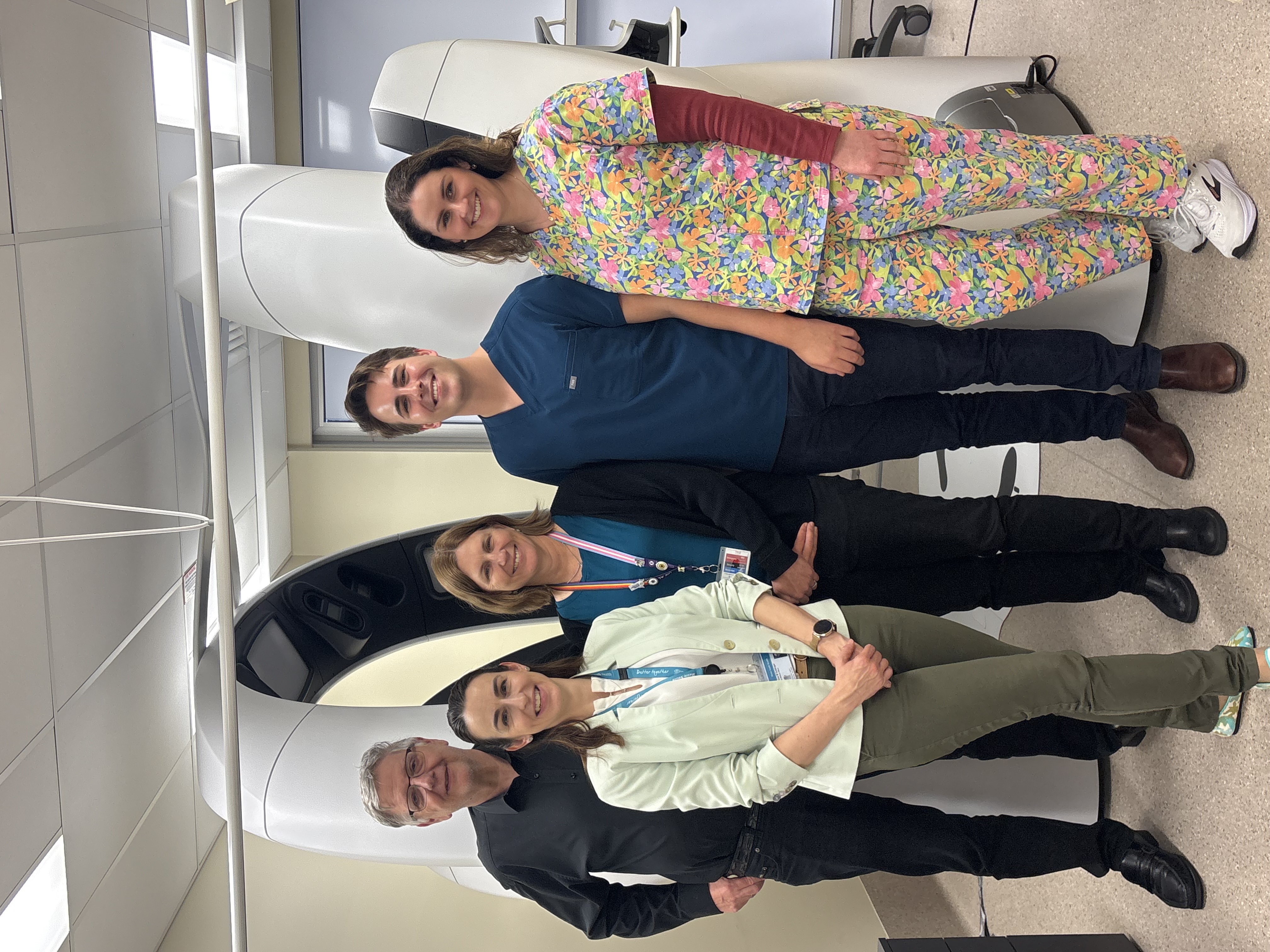
Princess Alexandra Hospital ACEMID and High-Risk Melanoma Clinic Team (left to right) Prof H. Peter Soyer, A/Prof Simone Goldinger, Ms Jenny Berkman (Genetic Counsellor), Dr Sam Kahler, Ms Kaitlin Nufer (Clinical Trials Coordinator).
It started, in melanoma researcher Sam Kahler's words, as a 'Frankenstein held together with scaffolding'. What that early prototype of the Vectra 3D Photography Machine has grown into the most significant skin cancer research programs in the country, helping detect melanomas that even experienced clinicians might otherwise miss. None of it would have been possible without PA Research Foundation donors who backed the idea in its earliest, most experimental form.
Dr Sam Kahler is a researcher with ACEMID (Australian Centre of Excellence in Melanoma Imagine and Diagnosis), the program that grew out of that original prototype and now runs the state of the art Vectra 3D total body photography system across 15 sites in Queensland, New South Wales and Victoria, with PA Hospital as the very first site. Sam wasn't around for those early days, but he has spent enough time with the original dataset and patients to understand what that first bit of belief made possible.
"You don't make advances without that first leap of faith," Sam said.
"And there was no guarantee this was all going to work. Early support from the PA Foundation, and the leap of faith from the patients and the research team started as service, which was the segue into that first NHMRC (National Health and Medical Research Council) foundation grant awarded to Professor H Peter Soyer that kicked this all off."
That grant awarded to Professor H Peter Soyer, marked the beginning of an east coast collaboration to shape what would become ACEMID.
Fast forward to today and close to 10,000 people have now been recruited into the study across Australia, giving researchers an extraordinary data set on population risk and, in Sam's words, one of the most thorough and high-tech skin cancer surveillance services provided globally. PA's early involvement means the hospital holds long-term follow-up on its patients stretching past a decade, as well as personalised genetics and histopathology, positioning it as a leading voice in the wider collaboration.
Alongside ACEMID, the Vectra system underpins PAH Dermatology's High Risk Melanoma Clinic, led by A/Prof Simone Goldinger (Dermatologist and Research Fellow), Dr Sam Kahler, Ms Kaitlin Nufer (Clinical Trials Coordinator), and Jenny Berkman (Genetic Counsellor). The clinic pairs Vectra surveillance with genetic testing for patients with a higher-than-average risk of melanoma, so each patient receives surveillance that is tailored to their own risk profile.
Importantly, the research which also uses Artificial Intelligence alongside the Vectra images is not about replacing a clinician's judgement, but rather synthesizing information for the clinician and patient to action. Rather than relying on questions like how many sunburns a patient had when they were young, the Vectra measures more objective markers, skin type, mole count and distribution, sun damage, and soon, freckling patterns in younger patients. Put together, those measures give a more reliable assessment on who is likely to be affected by melanoma, how serious it might be, and where on the body it is likely to appear, in order to guide clinical surveillance. The next step is building a digital profile for each patient, tracking how their skin changes over time so subtle shifts can be detected earlier.
That precision is already changing outcomes. Sam described a recent case that stayed with him, a subtle change on one patient's scan that, in a routine setting, may not have been detected until a later stage.
"Using the Vectra, we were able to demonstrate that the lesion was new compared to previous images, and showing subtle dermoscopic changes across close follow-up appointments" Sam explained.
"The biopsy was consistent with an early diagnosis and the patient had a positive outcome."
The reach of the program matters as much as its precision. With sites now as far afield as Mount Isa, patients recruited to ACEMID receive the latest advances in melanoma detection, are reviewed by PAH Dermatologists, all whilst contributing to research.
What makes the work encouraging, Sam said, is that better detection doesn't necessary have to involve more intervention intention. Serial monitoring supported virtual clinician assessment may result in fewer excisions whilst maintaining early detection of melanoma.
"We're essentially, on one hand, taking a step back in terms of how much we have to intervene in a patient's journey, while achieving just as excellent outcomes, which is really encouraging."
None of it would exist without that first bit of faith shown by PA Research Foundation donors, in a prototype that looked nothing like the sophisticated system operating today in three states. It is a reminder of what early support can grow into, and why the Foundation's donors remain such a vital part of the story. If you would like to help back the next leap of faith in melanoma and skin cancer research, you can make the Foundation your place to give here.