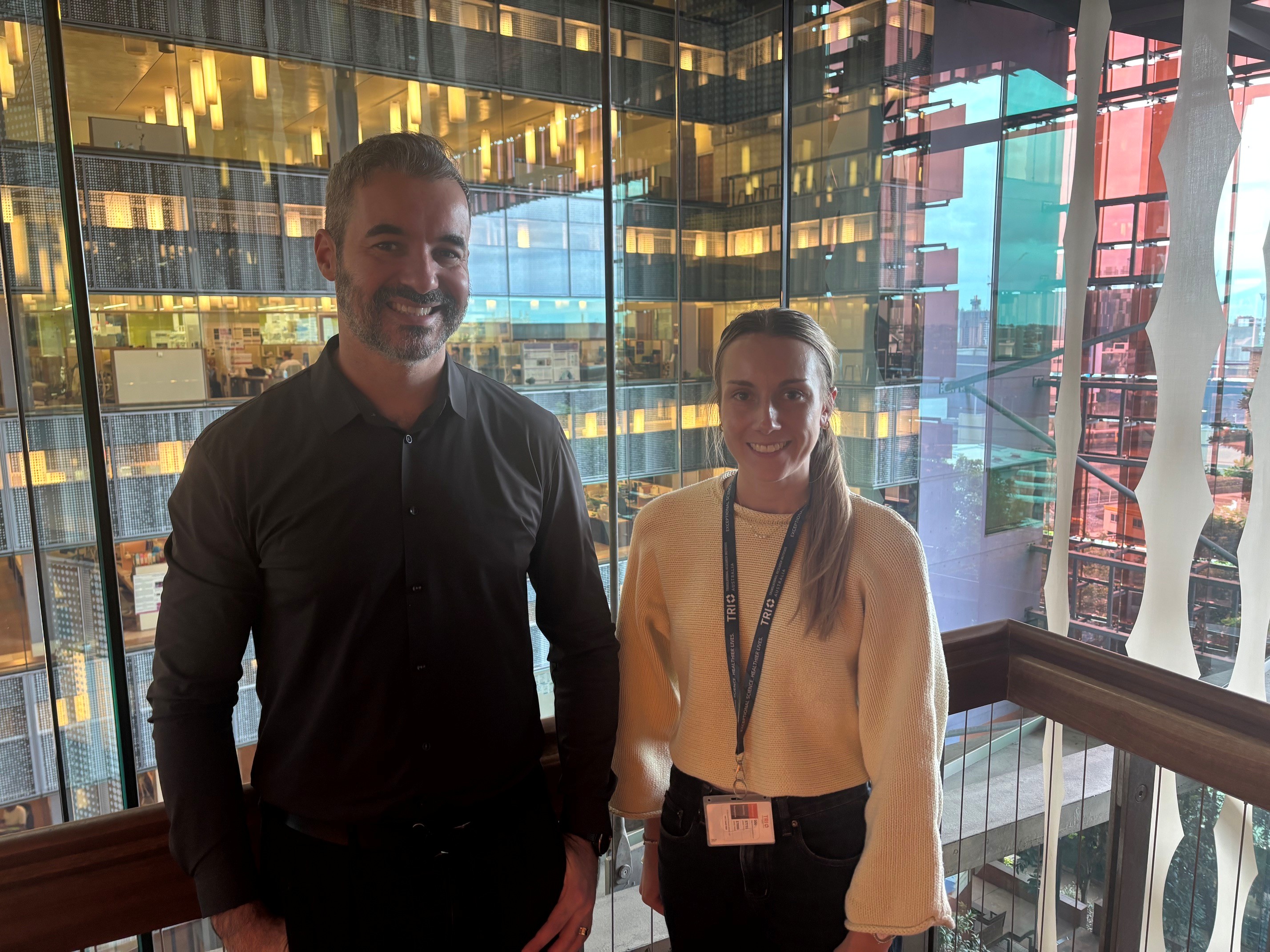
Can turning a cold tumour hot be the key to treating a rare and deadly cancers? That's the question researcher Associate Professor (A/Prof) Fernando Guimaraes and PhD student Jessica Grant are working to answer, thanks to the PA Research Foundation.
Pseudomyxoma peritonei affects as few as one or two in a million people. It starts in the appendix and produces a mucinous substance that fills the abdomen, which is why it's sometimes known, plainly, as ‘jelly belly’ cancer. It carries close to a 50 per cent mortality rate, and treatment options haven't meaningfully changed in decades.
"It's a rare cancer that's notoriously resistant to current therapeutics," A/Professor Guimaraes said.
"Jessica and I are trying to take advantage of the new technologies available today to understand this cancer, before we're able to propose a potential new therapy that could work against it."
To do that, A/Prof Guimaraes and Jessica are mapping the tumour's microenvironment cell by cell, using a spatial multiomics platform called Codex.
"We've used a panel with 60 different markers to detect all the different types of immune cells, the tumour cells, their functional states, things like that," Jessica explained.
"We're currently going through the process of identifying all the cells within the tumour, figuring out what cell type they actually are, so we can see if there's any patterns, like whether those immune cells are actually infiltrating the tumour or not, whether it's a hot tumour or a cold tumour."
A hot tumour is one the body’s immune system is actively fighting. A cold tumour is one where the immune cells can't get in, or have been switched off before they get the chance. According to A/Prof Guimaraes understanding why a tumour is cold, is itself a therapeutic opportunity. If researchers can work out what's blocking the immune response, they may be able to unblock it.
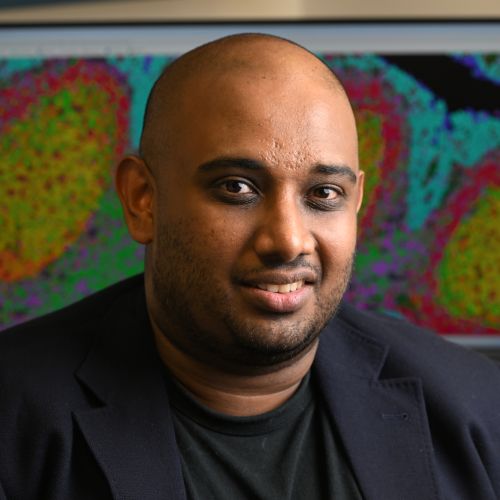
None of this mapping work is happening in isolation. A/Prof Guimaraes and Jessica's research sits alongside the long-running work of A/Prof Arutha Kulasinghe, whose multiomics and spatial profiling research the Foundation has proudly backed for many years. A/Prof Kulasinghe is Jessica's co-supervisor and a close collaborator of A/Prof Guimaraes, and the two teams lean on each other's strengths.
"He is our mentor on this technology of spatial multiomics," A/Prof Guimaraes said.
"We are the immunologists, the immunotherapy experts. Arutha and us, we are highly complementary. He comes with this multiomics capacity, and we come with the immunotherapy development and preclinical assessment."
Combining their work with A/Prof Kulasinghe’s is powerful because A/Prof Guimaraes’ team also holds cell lines derived from patients with this specific cancer, giving them the ability to test new drugs in the lab against a disease so rare that most researchers never encounter it.
Because pseudomyxoma peritonei is so uncommon in Australia, the research team has drawn on samples from overseas, including from Brazil's much larger population, to build a big enough patient cohort to work from. Closer to home, PA oncologist Dr Kate Roberts whose work has also been supported by the Foundation in the past, is now referring patients into the project, with hopes of collecting samples locally in the near future.
None of it would exist at all without a generous gift in memory made through the Foundation. Genni Lynch was a nurse at the PA Hospital who developed pseudomyxoma peritonei de novo and passed away from the disease. Her husband, Stephen Lynch, was a former chair of surgery and is also a long standing member of the PA Research Foundation board. Following Genni’s untimely passing her family encouraged support through the Foundation in her memory.
"It's everything," A/Prof Guimaraes said, of what that gift has meant.
"We would never be able to contribute to research on this specific topic if we didn't get a gift like this. We have the capacity to extend our immunotherapeutic development to other cancers such as this, but we would never be able to do it if it wasn't for such generous gift from the Lynch family."
It's early days in terms of the project but both Fernando and Jessica hope this work is a first step on a path that, in a decade's time, could lead to a clinical trial and, eventually, an immunotherapy option for a cancer that currently has almost none. It is exactly the kind of long, unglamorous, foundational research that rarely attracts funding of its own, and exactly the kind that an incredibly generous can make possible.
If you would like to help researchers like A/Prof Guimaraes and Jessica to find solution for rare cancers and serious diseases, you can make the Foundation your place to give here.